Adolescence needs a few things that are hard to schedule: a hard workout that isn't a screen, a group of peers who show up on purpose, and a set of adults who take teenagers seriously.
The teens program does all three. Classes are age-grouped and separate from the adult schedule, so 13–17-year-olds train with peers instead of with adults or younger children. The technique is real BJJ, the same curriculum the adult beginners learn, taught at a pace that matches teenage bodies and attention spans.
Coaches are black belts who know how to run a demanding room without making it dread-inducing. Sparring happens only when your teen is ready, with partners at their level, under close supervision. There's a competition team for kids and teens who want to test themselves; there's no pressure to compete for kids and teens who just want to train.
BJJ is leverage and control, not striking. Your teen learns how to stay safe on the ground, how to de-escalate a physical situation, and how to walk away from fights they don't need to be in.
Losing on the mat is fast, cheap, and constant. That's the feature. Your teen learns to lose small, adjust, and try again, the skill that transfers to school, sport, and every relationship they'll have.
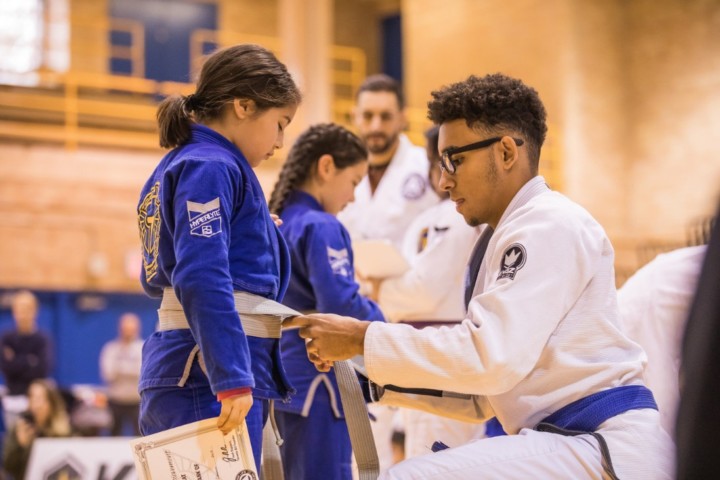
Teens training with teens, under coaches who care. The room is competitive without being cruel, and the friendships that come out of it tend to last past graduation.
The teens program is designed as a bridge. By the time a student ages up at 18, they've built the base (technique, mat time, sparring experience) to step into the adult room without missing a beat. Many of our current adult members came up through the teens program.
Teens who want to compete have a track for it. Teens who just want a hard, fun, non-screen thing to do three nights a week have a track for that too. Both are valid; both are supported.
Seven days free for teens. We lend the gi. Email or call to book. Tell us your teen's age and any prior experience, and we'll place them in the right class.